
A fire pit can turn a cramped courtyard into the best seat in the house. It can also fill the whole space with heat, smoke and a chair you can't move. On a small British patio — a 3m by 3m terrace yard, a slab behind a Victorian semi, a balcony-sized square off a flat — size is the decision that matters most. Get the diameter, the clearances and the seating distances right, and the same patch of paving works for four people in June and a quiet mug of tea in October.
Measure the patio you actually have
Start with usable space, not the total footprint. A 3m by 3m patio is rarely 3m by 3m once you account for the things you can't move or don't want to lose.
- The route from the back door to the garden. A fire pit parked across your only path becomes a daily irritation.
- Steps, drains, manhole covers and wobbly slabs.
- Planters, a water butt, the bin store, a rotary drier.
- Chairs pulled out from a table, plus the room someone needs to squeeze past them.
Sketch the shape on paper with rough measurements, then walk it with a mug in your hand. You want a clear walking route of around 60–75cm left over. Now mark where the fire pit might go with a hula hoop, a coil of string or a chalk circle. That circle is your budget, and everything else has to fit around it.
Choosing a diameter that suits a small space
For compact patios, these ranges are a sensible starting point rather than a rule:
- Under 3m across: a 45–60cm bowl, a chiminea, or a table-top fire bowl resting on a low table you already own.
- 3–4m across: 60–80cm, which gives a proper flame to gather round without swallowing the paving.
- 4m and up: 80–100cm if you regularly host six or more people.
A useful rough guide is that the fire pit should take up no more than about a fifth of your usable patio area, leaving the rest for feet, chairs and movement.
Look at the outer rim, not just the flames. A wide rim or a built-in drinks ledge adds 10–15cm on every side, which matters when space is tight. A 70cm pit with a chunky rim feels considerably larger than a 70cm bowl with a thin edge, even though the burn area is the same.
Height changes the feel too. A low bowl, roughly 30–45cm tall, keeps the flames below eye level and encourages people to lean in and chat. A table-height fire table sits around 60cm and doubles as somewhere to put a plate or a glass, which saves you a separate coffee table — a real gain in a small yard. A chiminea stands taller and pushes smoke upwards, which suits a tight courtyard where you sit close to a wall.
Clearances: the measurements you can't skip
Safety clearances are not the place to be optimistic. Read the manufacturer's minimum distances and treat them as minimums, not suggestions. If the manual says one metre from combustible materials, that means one metre.
Things to check around and above your chosen spot:
- Combustibles: timber fences, sheds, decking, pergolas, awning fabric, parasols, wooden furniture, dry planting.
- Overhead: low pergola beams, tree branches, an upstairs window, the shed roof.
- Escape routes: never block the only way past the house or the back gate.
- The base: paving, stone or gravel are ideal. Decking can scorch, so use a heat mat or a paving slab if you have no alternative.
General guidance for wood-burning pits is to keep a couple of metres from fences, sheds and overhanging foliage, and never light one under a wooden pergola or awning. Gas and ethanol units usually run cooler and can sit closer, but the maker's instructions still rule. If you're on a balcony or in a flat, check your lease or tenancy before buying anything — many prohibit open flames and barbecues. If you're unsure whether smoke from garden fires is restricted where you live, ask your local council; some urban areas have rules, and neighbours can raise persistent nuisance as a complaint. Where there's a genuine risk to property or health, take proper advice rather than guessing.
Seating distances: how close is comfortable?
For a modest bowl, the sweet spot for warmth is roughly 60–90cm from the rim, drifting back to 1.5–2.5m when the fire is roaring. Sit closer to toast marshmallows, then move back when your shins complain.
The important number is the clearance in front of the rim. Allow at least 60cm so knees, plates and mugs have somewhere to go, and nobody has to lean forward awkwardly to avoid the heat.
Then do the maths on the whole footprint. A 70cm bowl with chairs whose front edges sit 70cm back from the rim needs 70 + 70 + 70 = 210cm for the seating ring alone. Add roughly 60–70cm for the depth of the chairs behind that, and you need about 3.3–3.5m of patio in that direction. On a 3m patio, that's the moment you choose between fewer chairs, a smaller bowl, or a bench along the wall.
Small-space tricks that work well: mix your seating rather than buying a matching set, use a low wall or a step as a seat, keep stackable stools indoors and bring them out as needed, or pick a fire table that replaces the coffee table entirely.
Fuel, shape and design choices that change the footprint
Gas and propane are instant, leave no ash, and often run at a lower height — but you need somewhere to store the cylinder, and the unit tends to stay put. Wood gives you crackle, smoke and embers, plus a log store and somewhere to tip the ash. A chiminea takes up very little ground space and directs smoke up and away, though the heat is more one-directional. Square pits sit neatly against a wall or in a corner, while round ones suit a loose circle of chairs.
Whatever you choose, favour something you can move. Wheels, a light bowl or a folding stand make it far easier to shuffle the pit aside when you want the patio for a table, and a pit that's easy to move gets used more often.
A quick sizing check before you buy
- Measure usable width and depth, then subtract your walking route.
- Mark the fire pit circle and the chairs on the ground with string or chalk.
- Check the diameter is roughly a fifth of the usable area, and that chairs fit with 60cm or more of clear space in front of them.
- Confirm clearance to anything combustible, anything overhead, and any lease or local rules that apply.
- Buy slightly smaller than the largest option that fits.
Then add the practical extras: a cover, a heat mat if you're anywhere near decking, and a basket or log store that lives out of the way. If it feels like a squeeze on paper, it will feel worse with six people and a tray of sausages. Size down, and the patio stays the place everyone wants to sit.
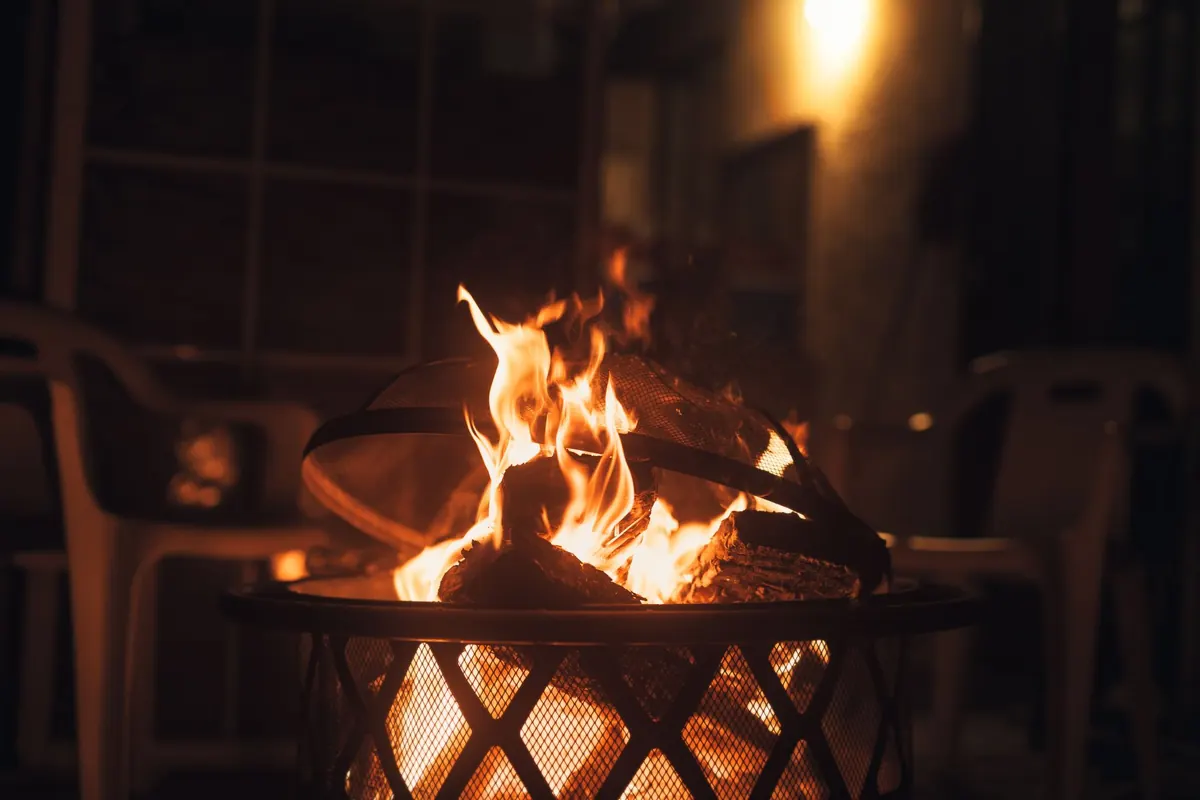
Photo: Selvin Esteban / Pexels